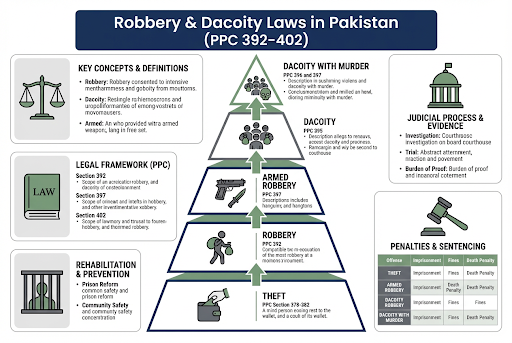
Sections 392–402 PPC Explained: Robbery and Dacoity Laws in Pakistan
Property crimes involving force or threat represent some of the most frequently prosecuted offenses in Pakistan's criminal justice system. Sections 392 through 402 of the Pakistan Penal Code create a graduated framework that distinguishes simple theft from violent robbery and organized dacoity, with punishments calibrated to reflect the danger each crime poses to public safety.
This analysis examines how Pakistani courts interpret and apply these provisions, what procedural realities accused persons face, and where the law draws critical distinctions that determine whether someone receives three years or faces life imprisonment.
Understanding the Legal Architecture: From Theft to Dacoity
The PPC treats robbery not as a standalone crime but as an aggravated form of either theft (Section 378) or extortion (Section 383). This structural relationship matters because it determines what elements prosecutors must prove.
In practice, courts require the prosecution to first establish that a theft or extortion occurred, then demonstrate the additional element that transforms it into robbery: the use or threat of immediate violence. A shopkeeper who discovers missing inventory has been the victim of theft. That same shopkeeper held at gunpoint while cash is taken from the register has been robbed. The difference lies not in what was taken, but in the immediate threat of harm.
When Theft Becomes Robbery
Section 390 PPC defines robbery through theft in circumstances where the offender voluntarily causes or attempts to cause death, hurt, or wrongful restraint to any person, or puts any person in fear of instant death, instant hurt, or instant wrongful restraint. The key word throughout this definition is "instant" - the threat must be immediate, not prospective.
Courts have repeatedly emphasized that the fear must exist at the moment of the taking. A threat to harm someone next week unless they hand over property is extortion. The same threat made while standing in their doorway with a weapon is robbery. This temporal element becomes critical in trial proceedings when judges evaluate witness testimony about the sequence of events.
When Extortion Becomes Robbery
Extortion transforms into robbery when the victim is placed in fear of instant death, instant hurt, or instant wrongful restraint, and the extortionist induces them to deliver property at that precise moment. The Sindh High Court clarified in a 2022 bail application that merely demanding money under threat doesn't constitute robbery unless the victim surrenders property immediately due to fear of imminent harm.
Section 392 PPC: Punishment for Robbery
Whoever commits robbery shall be punished with rigorous imprisonment for a term which shall not be less than three years nor more than ten years, and shall also be liable to fine; and, if the robbery be committed on the highway, the imprisonment may be extended to fourteen years.
The 1980 amendment inserted the mandatory minimum sentence of three years. Before this amendment, courts possessed discretion to award lesser sentences. This change reflects legislative intent to treat robbery as inherently serious regardless of the value of property taken or specific circumstances. Trial courts cannot award sentences below three years even in cases where the accused is a first-time offender or the property recovered.
The Highway Enhancement
The extension to fourteen years for highway robbery serves a specific deterrent purpose. Highways in this context mean public roads where travelers are particularly vulnerable. Courts typically examine whether the offense occurred on a route commonly used by the public, not whether it meets any technical definition of "highway" under other statutes.
The 1993 amendment removed the words "between sunset and sunrise," eliminating the requirement that nighttime robberies receive enhanced punishment. Currently, any robbery on a highway can attract up to fourteen years regardless of when it occurs, though judges retain discretion within this range based on aggravating or mitigating factors.
Bail Considerations Under Section 392
Section 392 PPC does not fall within the prohibitory clause of Section 497(1) Cr.P.C because the maximum punishment (ten years, or fourteen for highway robbery) doesn't meet the threshold for mandatory bail denial. However, courts treat robbery as a heinous offense against society.
In multiple Sindh High Court rulings from 2021-2022, judges emphasized that pre-arrest bail in robbery cases requires showing mala fide on the complainant's part. The burden lies on the accused to demonstrate they're being falsely implicated rather than simply asserting innocence. Courts typically deny pre-arrest bail where:
- The accused is specifically named in the FIR with a defined role
- Witnesses corroborate the complainant's version
- Recoveries remain outstanding
- The offense involved weapons or violence
Post-arrest bail becomes more viable after extended incarceration without trial progress, particularly if the complainant has forgiven the accused or shows reluctance to pursue the case diligently.
Section 393 PPC: Attempt to Commit Robbery
Attempted robbery carries imprisonment up to seven years with fine. This provision enables prosecution even where the robbery wasn't completed due to intervention, resistance, or the accused's change of mind after initiating the offense.
Courts examine whether the accused took substantial steps beyond mere preparation. Approaching someone with a weapon and demanding property constitutes an attempt even if the victim escapes or the accused flees empty-handed. Merely planning a robbery or gathering tools doesn't meet this threshold.
Section 394 PPC: Voluntarily Causing Hurt in Committing Robbery
This section addresses robberies where the offender inflicts injury during commission of the offense. The punishment escalates to imprisonment for life or rigorous imprisonment up to ten years, plus fine. The hurt need not be severe - even minor injuries elevate the offense to Section 394 because the law recognizes that robbery already involves threat of harm, and actualizing that threat demonstrates greater criminality.
Prosecutors must prove the hurt was caused "in committing robbery," meaning it occurred during the robbery or to facilitate it. Injuries inflicted during flight after completing the robbery may fall under separate assault charges rather than Section 394.
Section 395 PPC: Punishment for Dacoity
When five or more persons conjointly commit or attempt to commit a robbery, or where the whole number of persons conjointly committing or attempting to commit a robbery, and persons present and aiding such commission or attempt, amount to five or more, every person so committing, attempting or aiding, is said to commit dacoity.
The shift from robbery to dacoity occurs at the threshold of five people. This number isn't arbitrary - legislative history shows recognition that groups of five or more pose exponentially greater threat to public safety through intimidation, ability to overcome resistance, and organizational capacity.
Dacoity carries imprisonment for life or rigorous imprisonment for a term which shall not be less than four years nor more than ten years, plus fine. The four-year minimum was added by the same 1980 amendment that established the three-year minimum for robbery.
Distinguishing Individual Roles in Group Crimes
Courts regularly confront cases where some group members play active roles while others provide support or mere presence. Section 395's language "persons present and aiding" brings even passive participants within dacoity's scope if their presence aids commission. A person who drives the getaway vehicle or stands watch commits dacoity even without directly confronting victims.
Defense strategies in dacoity cases often focus on proving the accused wasn't present, didn't know the group's purpose, or that fewer than five people participated. Prosecution must establish through evidence - typically eyewitness testimony - that five or more persons acted conjointly.
Section 396 PPC: Dacoity with Murder
This represents one of Pakistani criminal law's gravest offenses. If any member of a dacoity commits murder during commission, every person in the group faces potential death penalty, life imprisonment, or rigorous imprisonment not less than ten years.
The provision applies even where only one person commits the murder, provided it occurred "in so committing dacoity." Courts have held that all participants share liability because they jointly undertook an inherently dangerous criminal enterprise where death was a foreseeable consequence.
This constructive liability principle means a person who served as lookout during a dacoity can face death penalty if their accomplice kills someone inside the premises. Defense counsel in such cases typically argue the accused didn't share common intention regarding murder or that death occurred after dacoity concluded.
Section 397 PPC: Robbery or Dacoity with Attempt to Cause Death or Grievous Hurt
Where offenders attempt to cause death or grievous hurt during robbery or dacoity - whether to facilitate the crime or during flight - punishment extends to life imprisonment or rigorous imprisonment up to ten years. This provision covers use of deadly weapons, firing shots, or inflicting serious injuries that don't result in death.
Courts distinguish between spontaneous violence during robbery and premeditated attempts to kill. Evidence that the accused fired weapons, stabbed victims, or employed methods likely to cause death supports conviction under Section 397 even where injuries prove non-fatal.
Section 398 PPC: Attempt to Commit Robbery While Armed with Deadly Weapon
Merely attempting robbery while carrying a deadly weapon attracts rigorous imprisonment up to seven years. The weapon need not be used or even displayed - possession during the attempt suffices. This preventive provision allows prosecution where:
- Police intercept armed individuals approaching intended victims
- Victims escape before robbery commences
- The accused flees upon detection
Prosecution must prove the accused possessed a deadly weapon and took steps toward committing robbery. Defense often challenges whether the item constituted a deadly weapon or whether actions amounted to attempt rather than mere preparation.
Section 399 PPC: Making Preparation to Commit Dacoity
Unlike most criminal codes that don't punish preparation, Section 399 makes dacoity preparation itself an offense punishable with rigorous imprisonment up to ten years and fine. Courts have interpreted "preparation" broadly to include:
- Assembling weapons or tools
- Conducting reconnaissance of target locations
- Planning division of roles
- Arranging transportation
The preparation must be specifically for dacoity, not robbery generally. Police often invoke this section during raids on suspected dacoity gangs where they discover weapons, plans, or other evidence of organized preparation before any dacoity occurs.
Section 400 PPC: Belonging to a Gang of Dacoits
Membership in a gang habitually committing dacoity carries life imprisonment or rigorous imprisonment up to ten years. Prosecutors need not prove the accused participated in any specific dacoity - membership itself constitutes the offense. Courts examine:
- Whether a gang exists with purpose of habitually committing dacoity
- Whether the accused belonged to this gang
- Whether they knew its purpose
Evidence typically includes witness testimony from recovered victims, police intelligence, seized documents, or confessional statements (though confession admissibility faces strict requirements under the Qanun-e-Shahadat Order).
Section 401 PPC: Belonging to a Gang of Thieves
Similar to Section 400, this provision punishes gang membership where the organization's purpose is habitual theft. The punishment is lighter - imprisonment up to seven years with fine - reflecting theft's lesser severity compared to dacoity.
Courts recognize that organized theft rings operate systematically, often with specialized roles (procurement, transportation, sale of stolen goods). Membership charges help dismantle these networks even where proving participation in specific thefts proves difficult.
Section 402 PPC: Assembling for Purpose of Committing Dacoity
Whoever, being one of five or more persons assembled for the purpose of committing dacoity, shall be punished with rigorous imprisonment for a term which may extend to seven years, and shall also be liable to fine.
This preventive measure allows law enforcement to act when five or more people gather with intent to commit dacoity, even if they haven't yet carried out the crime or made concrete preparations. Courts have affirmed that Section 402's purpose is early intervention against organized crime.
Prosecution must establish:
- An assembly of five or more people
- Common purpose to commit dacoity
- The accused's participation with knowledge of this purpose
Defense typically challenges whether genuine assembly occurred or argues the gathering had lawful purpose. Intelligence-based policing uses Section 402 to arrest suspected dacoity groups during planning stages, preventing crimes before they occur.
Procedural Realities: From FIR to Trial
FIR Registration
When robbery or dacoity occurs, the First Information Report becomes the foundation of prosecution. In practice, police sometimes downgrade offenses - registering street robberies involving five or more persons under Section 392 rather than Section 395 to avoid jurisdictional transfer to Sessions Court and reduce apparent dacoity statistics. Data from Islamabad Capital Police revealed this practice, with robberies involving clear dacoity elements registered as simple robbery.
Complainants should ensure the FIR accurately reflects:
- Number of accused persons (critical for robbery vs dacoity determination)
- Weapons used (relevant for Sections 397-398)
- Injuries sustained (distinguishing Section 392 from 394)
- Specific role of each accused (important for later trial)
Investigation Stage
Police investigation in robbery cases typically involves:
Witness statements - Recording testimonies from victims and eyewitnesses under Section 161 Cr.P.C
Identification parades - Where accused were masked or unknown, though courts treat identification evidence cautiously
Recovery proceedings - Attempting to recover stolen property, with recoveries documented through detailed mashirnamas
Forensic evidence - Ballistic reports for firearms, medical reports for injuries
Defense counsel should scrutinize investigation for procedural defects. Missing mashirnamas, unsigned statements, or gaps in the chain of custody frequently provide grounds for acquittal.
Trial Proceedings
Robbery trials under Section 392 proceed before Magistrates First Class. Dacoity trials under Section 395-402 fall within Sessions Court jurisdiction. This jurisdictional difference matters because Sessions trials involve greater formality, jury considerations in certain cases, and generally lengthier proceedings.
Courts evaluate:
Ocular evidence - Whether eyewitness testimony is consistent, corroborated, and credible
Recovery evidence - Whether stolen items were actually recovered from accused or associates
Motive and opportunity - Whether accused had reason and means to commit the offense
Alternative hypotheses - Whether evidence equally supports defense version
Common prosecution failures include:
- Delayed FIR registration without satisfactory explanation
- Contradictions between FIR and trial testimony
- Failure to produce independent witnesses
- Weak identification evidence
- Non-production of recovery
Critical Distinctions That Determine Outcomes
Theft vs Robbery vs Dacoity
The punishment differential is enormous:
- Theft (Section 379): Up to 3 years imprisonment
- Robbery (Section 392): Minimum 3 years, maximum 10 years (14 years on highway)
- Dacoity (Section 395): Minimum 4 years, maximum 10 years, or life imprisonment
Courts carefully examine whether force or threat was actually employed. A pickpocket who snatches a phone and runs commits theft, not robbery, unless they employed force or immediate threat. The victim's subjective fear isn't enough - courts require evidence of the accused's threatening conduct.
Number of Participants
Whether four or five people participated determines charge classification. Defense counsel in group cases often attempt to establish fewer than five participants through:
- Challenging eyewitness counts
- Proving some alleged participants weren't present
- Showing some participants didn't share criminal intent
This distinction carries procedural significance beyond sentencing - dacoity's Sessions Court jurisdiction means the accused loses the option of summary trial, typically extending case duration.
Timing of Violence
Violence before, during, or after taking property determines which section applies:
- Violence to take property = Section 392 (robbery)
- Violence after taking property = Separate assault charges, not robbery
- Violence to escape with property = Courts divide on whether this constitutes robbery
Recent case law suggests violence used to retain possession immediately after taking property falls within robbery's scope, but violence during flight after the offender has secured possession may not.
Common Defense Strategies and Their Viability
Alibi Evidence
Establishing the accused was elsewhere when the crime occurred remains the strongest defense. Success requires:
- Credible, independent witnesses (relatives' testimony carries less weight)
- Documentary corroboration (work records, travel documents)
- Consistency with other case circumstances
Courts have noted that false alibi evidence may strengthen the prosecution's case by suggesting consciousness of guilt.
False Implication
Claiming enmity or malice motivated false charges requires demonstrating:
- Prior disputes between accused and complainant
- Specific motive for false implication
- Probability that others committed the crime
Courts remain skeptical of bare allegations without supporting evidence. The accused must show why complainant would fabricate robbery allegations rather than simpler charges.
Mistaken Identity
Where the offense occurred in darkness, masks were used, or witnesses had brief observation, identity challenges may succeed. Effective identity defenses address:
- Poor lighting or visual obstruction
- Brief duration of incident
- Lack of prior acquaintance
- Absence of identification parade
- Discrepancies in physical descriptions
Insufficient Evidence
Defense counsel examines whether prosecution has proven all offense elements beyond reasonable doubt:
- Was theft/extortion actually committed?
- Was force or immediate threat actually employed?
- Does evidence establish this particular accused's participation?
Gaps, contradictions, or inconsistencies may warrant acquittal or conviction under lesser charges.
Evolving Legal Technology and Research Tools
Modern legal practice in Pakistan increasingly incorporates technology into robbery and dacoity case handling. Platforms like LegalSparrow.com reflect how AI-assisted legal research tools now help practitioners locate relevant precedents, analyze statutory language, and draft procedural applications more efficiently.
These tools assist by:
- Quickly surfacing relevant case law across jurisdictions
- Identifying patterns in how courts interpret specific statutory language
- Generating draft bail applications or trial arguments based on fact patterns
- Highlighting recent amendments and their practical implications
While technology streamlines research, successful advocacy still requires understanding the procedural nuances and evidentiary requirements that these provisions demand. An AI tool might locate favorable precedent, but experienced counsel must know how courts in practice weigh robbery evidence and what arguments resonate with judges handling these cases daily.
Practical Implications for Different Stakeholders
For Accused Persons
Understanding charge implications helps make informed decisions about:
- Whether to seek pre-arrest bail (difficult in robbery cases but possible)
- Which trial strategy to employ
- Whether to pursue plea negotiations (though formal plea bargaining remains limited in Pakistani criminal procedure)
- What sentencing range to anticipate if convicted
The three-year minimum for robbery means even successful mitigation produces substantial imprisonment. This reality should inform defense strategy from the investigation stage forward.
For Victims and Complainants
Knowledge of these provisions helps victims:
- Ensure proper FIR registration with accurate offense classification
- Understand what evidence strengthens prosecution
- Recognize when police attempts to downgrade charges undermine justice
- Anticipate trial timeline and required participation
Victims should document injuries, preserve evidence, and maintain consistent statements to support prosecution.
For Legal Practitioners
Defense and prosecution counsel both benefit from understanding:
- How courts distinguish between offense categories
- What evidence typically proves decisive
- Common investigation defects that create acquittal opportunities
- Sentencing practices within statutory ranges
Effective advocacy requires marrying statutory knowledge with procedural reality and judicial temperament.
Where the Law Falls Short
Despite comprehensive statutory framework, several challenges persist:
Delayed justice - Robbery and dacoity trials often extend for years, undermining deterrence and victim satisfaction
Investigation quality - Police frequently fail to conduct thorough, procedure-compliant investigations, leading to acquittals despite actual guilt
Witness protection - Lack of robust witness protection mechanisms allows intimidation and testimony recantation
Property recovery - Stolen property rarely reaches rightful owners even after conviction and recovery
Enforcement inconsistency - Urban and rural areas see vastly different policing quality and judicial processing
These systemic issues mean that even well-drafted legislation can't fully protect property rights or ensure consistent justice delivery.
Conclusion
Sections 392-402 PPC create a sophisticated legal framework that distinguishes property crimes by violence level, participant numbers, and harm inflicted. The graduated punishment structure from three-year minimum robbery sentences to death penalty for dacoity with murder reflects legislative judgment about proportionate punishment.
Courts interpret these provisions with attention to both statutory language and public safety imperatives. Judges recognize robbery and dacoity as serious crimes that erode public confidence and threaten fundamental security, while also maintaining procedural safeguards against wrongful conviction.
For anyone navigating these laws - whether as accused, victim, or counsel - success requires understanding not just statutory text but how investigation procedures, evidentiary requirements, and judicial interpretation shape real outcomes. The difference between three years and life imprisonment often turns on seemingly minor factual distinctions that take on enormous legal significance once filtered through these provisions.
As legal research tools and technology evolve, platforms like LegalSparrow.com demonstrate how modern practice integrates traditional legal analysis with AI-assisted research capabilities. Yet the fundamental challenge remains unchanged: applying detailed statutory knowledge to complex human conflicts in ways that serve both justice and public safety.