SECP Company Registration in Pakistan: Complete Process, Requirements & Costs
The Securities and Exchange Commission (SECP Pakistan) functions as Pakistan's primary corporate and financial regulatory authority, the institutional bridge between entrepreneurial ambition and legal corporate existence. Established under the Securities and Exchange Commission of Pakistan Act 1997 and operational since January 1, 1999, the SECP evolved from its predecessor, the Corporate Law Authority (CLA), to become an autonomous regulatory body with vastly expanded powers.
What is SECP Pakistan? Definition and Mandate
Official Definition: The SECP is a higher regulatory body charged with developing a modern, efficient corporate sector and capital market based on sound regulatory principles to foster investment and economic growth in Pakistan.
Regulatory Scope: Unlike single-purpose regulators, the SECP exercises jurisdiction over:
- Corporate sector: Company incorporation, governance, compliance under the Companies Act 2017
- Capital markets: Pakistan Stock Exchange (PSX), securities trading, broker licensing
- Insurance sector: Life and non-life insurance companies, takaful operators
- Non-Banking Finance Companies (NBFCs): Leasing, investment finance, housing finance, microfinance
- Private pension schemes and asset management services
Why SECP Matters for Company Registration: Every private limited company, public limited company, single member company, or specialized entity (e.g., Section 42 not-for-profit companies) operating in Pakistan must obtain SECP registration to achieve legal personality. Without this registration, businesses cannot:
- Open corporate bank accounts
- Enter enforceable contracts in the company's name
- Issue shares or raise capital
- Claim tax deductions as a registered entity
- Protect shareholders through limited liability
The SECP's company registration function operates through nine Company Registration Offices (CROs) strategically located in Islamabad, Karachi, Lahore, Multan, Peshawar, Sukkur, Faisalabad, Quetta, and Gilgit-Baltistan.
SECP's Regulatory Evolution: From CLA to Modern Regulator
Historical Development:
The journey from bureaucratic bottleneck to relatively streamlined digital regulator reflects Pakistan's broader economic liberalization:
- 1963: Board of Company Law Administration (BCLA) established under the Companies Act 1956
- 1984: Companies Ordinance 1984 created the Corporate Law Authority (CLA)
- 1997: SECP Act 1997 passed, dissolving CLA and establishing SECP
- January 1, 1999: SECP became operational with administrative and financial autonomy
- 2017: Companies Act 2017 replaced the 1984 Ordinance, modernizing corporate law
- 2020-present: Digital transformation through eZfile online registration system
Why This History Matters: The transition from CLA to SECP represented a philosophical shift from a control-focused bureaucracy to a facilitative regulator. The Companies Act 2017 further modernized the framework by:
- Introducing single member companies (allowing solo entrepreneurship)
- Streamlining incorporation processes
- Enhancing corporate governance standards
- Aligning Pakistani law with international best practices
Understanding this evolution helps explain current SECP proceduresmany requirements reflect legacy compliance structures, while recent reforms demonstrate increasing digitization and entrepreneur-friendliness.
SECP's Regulatory Functions: Beyond Company Registration
While company registration constitutes SECP's most visible function for entrepreneurs, understanding its broader mandate clarifies why compliance extends beyond initial incorporation.
Corporate Sector Oversight
Primary Functions:
- Incorporation and registration: Processing applications under the Companies Act 2017
- Post-incorporation compliance: Monitoring annual returns, financial statements, shareholding changes
- Corporate governance enforcement: Ensuring boards comply with governance codes
- M&A and restructuring oversight: Approving mergers, amalgamations, schemes of arrangement
- Winding up and dissolution: Supervising voluntary and court-ordered liquidations
Practical Implication for New Companies: SECP registration is not a one-time event but the beginning of an ongoing compliance relationship. Companies must file:
- Annual returns within 30 days of each AGM
- Audited financial statements annually
- Notices of director/shareholding changes within 14 days
- Forms for significant corporate actions (capital changes, registered office shifts)
Failure to maintain compliance triggers penalties under Section 502 of the Companies Act 2017 ranging from PKR 25,000 to PKR 5 million depending on the violation.
Capital Market Regulation
SECP's Market Oversight:
- Pakistan Stock Exchange (PSX) regulation: Supervising exchange operations, listing requirements, trading practices
- Securities brokerage licensing: Authorizing and monitoring brokerage houses
- IPO oversight: Scrutinizing prospectuses, ensuring investor disclosure
- Mutual fund and collective investment scheme regulation
Relevance to Private Companies: While most startups won't immediately engage with capital markets, SECP's capital market functions become critical if a company plans to:
- Go public through an IPO
- Issue corporate debt instruments (TFCs, Sukuk)
- List on the PSX Growth Enterprise Market (GEM) for SMEs
Understanding that the same regulator governs both incorporation and eventual capital raising helps explain SECP's emphasis on accurate initial documentation, your incorporation records form the foundation for all future corporate actions.
Insurance and NBFC Supervision
Companies operating in specialized sectors face additional SECP licensing beyond standard incorporation:
Insurance Sector:
- Life insurance companies
- Non-life (general) insurance companies
- Takaful operators (Islamic insurance)
- Insurance brokers and corporate agents
NBFCs Requiring SECP Registration:
- Leasing companies
- Investment finance companies
- Housing finance providers
- Microfinance institutions
- Modaraba companies (Islamic investment vehicles)
- Asset management companies
Layered Compliance: If you're incorporating an NBFC or insurance company, you face a two-stage process:
- Standard incorporation through the CRO (like any company)
- Sector-specific licensing through SECP's specialized departments (Insurance Division, NBFC Division)
The sector-specific license requires demonstrating minimum capital requirements (often PKR 500 million to several billion), fit-and-proper criteria for directors, and comprehensive business plans.
Company Registration Under SECP: Legal Framework
The Companies Act 2017: Foundation of Corporate Law
The Companies Act 2017 replaced the Companies Ordinance 1984, introducing substantial reforms while maintaining core incorporation principles.
Key Innovations in the 2017 Act:
Single Member Companies (Section 2(70)): Previously, companies required a minimum two members. The 2017 Act permits one-person companies, enabling solo entrepreneurs to operate with limited liability protectiona significant shift for freelancers, consultants, and individual proprietors wanting corporate structures.
Enhanced Director Liability: The Act imposes personal liability on directors for fraudulent conduct, shadow directorship, and breach of fiduciary duties (Sections 188-197), raising governance stakes.
Streamlined Incorporation: Sections 12-19 establish clearer incorporation procedures, electronic filing mechanisms, and reduced documentation requirements compared to the 1984 Ordinance.
Special Purpose Vehicles: The Act explicitly recognizes various corporate forms:
- Private limited companies (Pvt. Ltd.)
- Public limited companies (Ltd.)
- Single member companies (SMC-Pvt.)
- Section 42 companies (not-for-profit)
- Companies limited by guarantee
Recent Amendments (2024): SECP issued the Companies Regulations 2024, incorporating 183 proposed amendments to streamline regulatory processes and enhance ease of doing business. These amendments address procedural bottlenecks identified through post-2017 implementation experience.
Types of Companies You Can Register with SECP
1. Private Limited Company (Pvt. Ltd.)
Characteristics:
- 2 to 50 members maximum (Section 2(62))
- Restrictions on share transferability (must be approved by directors)
- Cannot invite public to subscribe shares
- Most common structure for SMEs, startups, family businesses
Why Choose This:
- Limited liability protection
- Separate legal personality (company owns assets, incurs liabilities independently)
- Professional credibility over sole proprietorships
- Easier to raise investment from angel investors/VCs
- Perpetual succession (company survives founder changes)
Minimum Requirements:
- Minimum 2 directors (can be the same as shareholders)
- Minimum 2 shareholders (unless structured as single member company)
- Minimum capital: No statutory minimum (can be PKR 100 or PKR 100 millionyour choice)
2. Single Member Company (SMC-Pvt.)
Legal Basis: Section 2(70) of Companies Act 2017
Unique Features:
- Only ONE shareholder required
- Must appoint a nominee (who inherits shares if sole member dies/becomes incapacitated)
- Same limited liability benefits as regular Pvt. Ltd.
- Full corporate personality despite single ownership
Ideal For:
- Freelancers and consultants wanting corporate structure
- Solo entrepreneurs testing business concepts
- Professionals (doctors, architects, engineers) setting up service firms
- Foreign investors incorporating local subsidiaries with 100% ownership
Practical Consideration: The nominee requirement (Section 131) is critical without a designated nominee, the company faces administrative complications upon the member's death. The nominee doesn't manage the company during the member's lifetime but automatically becomes the member upon death until estate distribution.
3. Public Limited Company (Ltd.)
Characteristics:
- Minimum 3 members, no maximum limit (Section 2(64))
- Can offer shares to the public
- Minimum 3 directors required
- More stringent compliance and governance requirements
When Required:
- Companies planning IPOs
- Large-scale enterprises with dispersed ownership
- Businesses requiring significant capital mobilization
- Certain regulated sectors mandating public company structure
Additional Compliance:
- Mandatory audit committee
- Corporate governance code compliance
- More extensive annual reporting
- Higher scrutiny from SECP
4. Section 42 Company (Not-for-Profit)
Purpose: Section 42 provides a corporate structure for non-profit entitiesNGOs, foundations, charitable trusts, educational institutions, professional associations.
Key Differences:
- Profits (if any) must be applied toward promoting stated objectives, not distributed to members
- "Limited by Guarantee" structure members guarantee a specified amount (often PKR 100-1,000 each) rather than holding shares
- Exemption from using "Limited" or "Pvt. Ltd." in the name
- Tax exemptions under Income Tax Ordinance 2001 (if approved)
Registration Requirements:
- Minimum 3 members
- Memorandum and Articles must specify non-profit objectives
- SECP scrutinizes objects clause to ensure genuine charitable/social purpose
- May require NOC from relevant regulatory body (e.g., Ministry of Education for educational NGOs)
SECP Company Registration Process: Step-by-Step
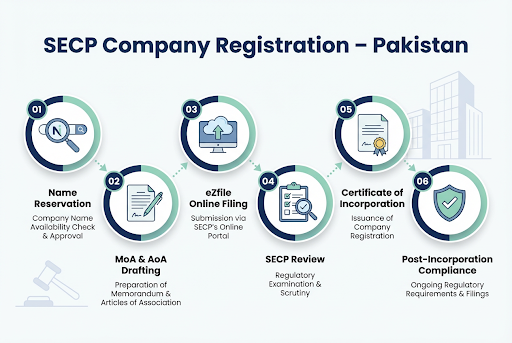
From a procedural standpoint, SECP company registration involves name reservation, document preparation, online filing through eZfile, payment of fees, and CRO approval. Understanding each stage prevents common mistakes that delay incorporation.
Step 1: Name Availability Search and Reservation
Why Name Matters: Your proposed company name must be unique, non-deceptive, and compliant with Section 10 of the Companies Act 2017 and Regulation 4 of the Companies Regulations.
Prohibited Names (Section 10):
Names cannot:
- Be identical or closely resemble an existing company's registered name
- Suggest government patronage without authorization ("Federal," "National," "State" require permission)
- Include words like "Bank," "Insurance," "Trust," "University" without relevant regulatory licenses
- Be scandalous, obscene, or offensive
- Mislead about the company's nature, objects, or size
How to Conduct Name Search:
- **Access SECP's Company Name Search Tool:
**- Visit www.secp.gov.pk [blocked]
- Navigate to "Company Name Search" (free service, no registration required)
- Enter proposed name variations
- **Search Strategy:
**- Check exact match first: "ABC Technologies (Pvt.) Ltd."
- Check close variations: "ABC Technology," "ABC Tech," "A.B.C. Technologies"
- Review phonetically similar names that could cause confusion
- **Evaluate Results:
**- "Available"proceed with reservation
- "Already Taken"choose different name
- "Too Similar to Existing"SECP will likely reject; modify substantially
Name Reservation Process:
If conducting name reservation separately from incorporation (recommended for complex cases):
- Submit Name Reservation Application through eZfile or manually at CRO
- Fee: PKR 200 for online, PKR 400 for offline
- Validity: Reserved name protected for 60 days from approval
- Extension: Can be extended once for additional 30 days upon request
Pro Tip from Practice: Reserve names well before finalizing incorporation documents. This 60-day window allows time to draft proper MoA/AoA, arrange director CNICs, and resolve shareholding negotiations without losing your preferred name to competitors.
Common Name Rejection Reasons:
- Too Generic: "Pakistan Traders (Pvt.) Ltd."SECP often rejects overly generic names
- Misleading Size Implication: "United Distributors" for a small startup suggests larger scale than reality
- Restricted Words: Including "Pharmaceutical" without Drug Regulatory Authority license
- Ethnic/Religious Sensitivity: Names that could be perceived as favoring particular communities
Step 2: Prepare Incorporation Documents
The documentation phase determines your company's constitutional framework. Rushed or poorly drafted documents create operational problems and potential disputes later.
Memorandum of Association (MoA)
Legal Purpose (Section 16): The MoA defines the company's relationship with the outside world its name, registered office location, objects (business purposes), share capital structure, and members' initial commitments.
Mandatory Clauses:
Clause IName: "The name of the company is [ABC Technologies (Private) Limited]"
Clause IIRegistered Office: "The registered office of the company will be situated in [Province], Pakistan."
Note: You must specify the province but can provide the exact street address later. Most companies initially register at their accountant's or lawyer's office for convenience.
Clause IIIObjects: This clause specifies what business the company can legally conduct. Post-2017 Act, object clauses are interpreted liberally, but clarity prevents ultra vires disputes.
Drafting Best Practices:
- Main Object: State your primary business clearly"To carry on the business of software development and IT consulting services"
- Ancillary Objects: Include supporting activities"To acquire intellectual property rights, enter software licensing agreements, provide technical training"
- General Objects: Add broad powers"To do all such things as are incidental or conducive to the attainment of the above objects"
Common Mistake: Overly narrow objects clauses restrict future business expansion. If you draft "To develop mobile applications for iOS platform only," expanding to Android later could technically fall outside your objectives, requiring MoA amendment (costly and time-consuming). Draft broad enough to accommodate reasonable business evolution.
Clause IVLimited Liability: "The liability of the members is limited."
For private/public companies, this is standard. For Section 42 companies, specify the guarantee amount: "Every member undertakes to contribute PKR 1,000 to the company's assets if it winds up while they are a member."
Clause VShare Capital: "The authorized share capital of the company is PKR [amount] divided into [number] ordinary shares of PKR [value] each."
Understanding Capital Structure:
- Authorized Capital: Maximum share capital the company can issue without amending MoA
- Issued/Paid-Up Capital: Actual shares issued to subscribers at incorporation
Example:
- Authorized: PKR 1,000,000 (10,000 shares × PKR 100 each)
- Issued at incorporation: PKR 100,000 (1,000 shares × PKR 100)
- Future flexibility: Can issue remaining 9,000 shares to new investors without MoA amendment
Practical Guidance: Set authorized capital generously. Increasing it later requires special resolution, SECP filing, and additional fees. Many companies set PKR 1-10 million authorized capital even if initial paid-up is only PKR 100,000.
Clause VISubscription: Lists founding members (subscribers) and their initial share commitments:
"We, the several persons whose names and addresses are subscribed below, are desirous of being formed into a company in pursuance of this Memorandum of Association, and we respectively agree to take the number of shares set opposite our respective names."
Each subscriber signs, states their CNIC, address, and number of shares taken.
Articles of Association (AoA)
Legal Purpose (Section 17): The AoA constitutes the company's internal governance framework, how directors are appointed/removed, how meetings are conducted, voting procedures, dividend distribution, share transfer restrictions.
Model Articles: The Companies Act 2017 provides model Articles (Table A for companies limited by shares). Companies can adopt these wholesale or customize them.
Key Provisions to Consider:
1. Share Transfer Restrictions (Critical for Pvt. Ltd.):
Standard private company AoA includes pre-emption rights: "No shares shall be transferred to a person who is not a member so long as any member is willing to purchase the same at fair value."
This prevents unwanted third parties from joining as shareholders. The board typically has discretion to approve/refuse transfers.
Customization Consideration: Startups raising venture capital often amend this to allow investors freedom to transfer shares to their affiliates while maintaining restrictions on founder transfers (preventing founders from selling out prematurely).
2. Board Composition and Powers:
- Number of Directors: "The company shall have minimum [2] and maximum [7] directors"
- Board Powers: "The business of the company shall be managed by the directors who may exercise all such powers of the company as are not by the Act or these Articles required to be exercised by the company in general meeting"
- Quorum: "Two directors present shall constitute quorum for board meetings"
3. General Meeting Procedures:
- Annual General Meeting (AGM): Must be held within 120 days of financial year-end (Section 131)
- Notice Period: Minimum 21 days for AGM, 14 days for Extraordinary General Meeting
- Voting Rights: "On a show of hands, each member present has one vote; on a poll, each share carries one vote"
4. Dividend Distribution:
"The company in general meeting may declare dividends, but no dividend shall exceed the amount recommended by the board of directors."
This ensures the board controls cash management while giving shareholders ultimate authority over profit distribution.
5. Winding Up Provisions:
Specifies how assets are distributed if the company dissolves typically proportional to shareholding after creditor payment.
Where to Find Templates:
SECP provides sector-specific model MoA/AoA templates on its website under "General Guide Books." These templates cover:
- Standard private limited companies
- Single member companies
- Public companies
- Section 42 not-for-profit companies
- Specialized sectors (insurance, NBFCs, etc.)
Critical Customization Areas:
While templates work for basic companies, customize for:
- Founder vesting schedules: Preventing founders from leaving with full equity immediately
- Investor rights: Reserved matters requiring investor consent (budgets, borrowing limits, major asset sales)
- Deadlock resolution: Mechanisms when shareholders disagree on fundamental decisions
- Drag-along/tag-along rights: Protecting minority and majority shareholders in exit scenarios
Common Drafting Mistakes:
-
Copy-Pasting Irrelevant Clauses: Using a manufacturing company's template for a tech startup includes unnecessary provisions about factory operations \
-
Contradicting Mandatory Provisions: AoA cannot override Companies Act mandatory requirements (e.g., cannot eliminate the statutory requirement for AGM) \
-
Vague Director Removal Provisions: Failing to specify notice requirements for removing directors creates disputes \
-
Inadequate Minority Protections: Majority shareholders can oppress minorities without proper AoA safeguards \
Step 3: Gather Required Documents
For All Companies:
1. Identification Documents:
- CNIC copies of all subscribers/proposed directors/chief executive (for Pakistani nationals)
- NICOP copies for non-resident Pakistani nationals
- Passport copies for foreign nationals
- Certified translations if foreign documents are not in English/Urdu
Important: All directors must be at least 18 years old. At least one director must be resident in Pakistan (Section 195).
2. Proof of Registered Office:
While not required at incorporation (you only specify province in MoA), you'll need this within 30 days post-incorporation when filing Form 21 (Notice of Registered Office).
Options:
- Own Property: Ownership documents
- Rented Office: Tenancy agreement
- Shared Office/Virtual Office: Many companies use accountants' or lawyers' addresses initially (ensure written permission)
3. Authorization for Filing:
If subscribers aren't personally filing the application, provide:
- Power of Attorney or authorization letter for the filing agent (typically corporate lawyer or chartered secretary)
For Specialized Companies:
4. Regulatory NOCs/Licenses:
Certain businesses require pre-incorporation approval from sectoral regulators:
- Banking: State Bank of Pakistan (SBP) license
- Insurance: SECP Insurance Division license-in-principle
- Securities Brokerage: SECP NCCPL registration
- NBFCs: SECP NBFC Division license-in-principle
- Pharmaceutical Manufacturing: Drug Regulatory Authority license
- Educational Institutions: Relevant education board/HEC recognition
- Oil & Gas: OGRA permissions
Process: Apply for license-in-principle or NOC first, then submit with incorporation documents. SECP won't register companies in these sectors without regulatory clearance.
5. Foreign Company Documentation:
If a subscriber is a foreign company (common for subsidiaries):
- Certificate of Incorporation from home jurisdiction
- Board Resolution authorizing investment in Pakistan
- Memorandum and Articles of the foreign parent
- Directors' details of foreign parent
- Certified translations and attestation by Pakistani embassy in home country
Step 4: File Through eZfile (Online) or Manual Submission
eZfile: SECP's Digital Incorporation Platform
Launched to streamline incorporation, eZfile allows complete online processing for standard companies.
How to Access:
- Visit https://eservices.secp.gov.pk
- Create user account (requires email verification)
- Select "Company Incorporation"
- Choose company type (Pvt. Ltd., SMC, Public, Section 42)
eZfile Process:
Step 1Name Availability Application:
- Can be combined with incorporation or done separately
- System checks against existing names in real-time
- Preliminary approval issued if available
Step 2Upload Documents:
- Scanned MoA (signed by all subscribers)
- Scanned AoA (signed)
- CNIC/Passport scans
- Regulatory NOCs (if applicable)
- Authorization letters
Document Format Requirements:
- PDF format
- Maximum 5 MB per file
- Clear, legible scans (rejected if illegible)
Step 3Complete Online Forms:
- Particulars of subscribers
- Director details
- Registered office province
- Company objects summary
Step 4Fee Payment:
- Online payment via credit/debit card or bank deposit
- Fee schedule based on capital (see fee section below)
- System generates payment voucher
Step 5Submission:
- Review all entries carefully/corrections post-submission require fresh application
- Submit electronically
- Receive acknowledgment number for tracking
Processing Timeline (eZfile):
- Official: 2-3 working days for standard companies
- Practical Reality: 3-7 working days, depending on CRO workload and document clarity
- Complex Cases (specialized sectors, foreign investors): 2-4 weeks
Common eZfile Technical Issues:
From practice experience:
- Upload Failures: Large file sizes or unstable internet cause timeouts compress PDFs before uploading
- Payment Gateway Errors: Use supported banks; some smaller banks' cards aren't accepted
- Form Validation Errors: System rejects certain special characters in names/addresses, avoid symbols, use plain text
- Status Tracking Delays: eZfile status may not update immediately, wait 24 hours before inquiring
Manual/Offline Submission Alternative:
If eZfile proves problematic or you prefer in-person filing:
- Prepare Physical Documents: Print MoA, AoA, and supporting documents
- Visit Relevant CRO: Attend the CRO with jurisdiction over your province
- Submit at Front Desk: Provide documents in duplicate, pay fees via bank challan
- Receive Acknowledgment: CRO issues manual receipt
Timeline (Manual): Typically 5-10 working days, as manual applications queue behind online ones in many CROs.
Which CRO Has Jurisdiction?
Based on the province specified in your MoA's registered office clause:
- Islamabad Capital Territory: Islamabad CRO
- Punjab: Lahore, Multan, or Faisalabad CRO (depending on specific city)
- Sindh: Karachi or Sukkur CRO
- Khyber Pakhtunkhwa: Peshawar CRO
- Balochistan: Quetta CRO
- Gilgit-Baltistan: Gilgit CRO
Pro tip: Karachi and Lahore CROs handle the highest volume except slightly longer processing times than smaller offices like Gilgit or Sukkur.
Step 5: SECP Review and Approval
What SECP Examines:
1. Compliance with Companies Act 2017:
- MoA and AoA conform to statutory requirements
- Minimum member/director thresholds met
- Objects clause not illegal or contrary to public policy
2. Name Approval:
- Final verification that name remains available and complies with Section 10
- No trademark conflicts with well-known brands
3. Document Authenticity:
- CNIC numbers verified against NADRA database
- Foreign document attestations checked
- Signatures appear genuine
4. Fee Payment:
- Correct fee amount paid
- Payment receipt/transaction ID valid
Possible Outcomes:
A. ApprovalCertificate of Incorporation Issued:
If everything is in order, SECP issues a Certificate of Incorporation containing:
- Company name
- Registration number (unique identifier, e.g., 0123456)
- Date of incorporation
- Company type (Pvt. Ltd., Public, etc.)
- SECP official seal and authorized signature
Legal Effect: From the date on the certificate, the company becomes a separate legal person with perpetual succession and limited liability.
Digital Delivery: eZfile users receive the certificate via email in PDF format, downloadable from their account. Physical copies can be collected from CRO or mailed.
B. Objection/Clarification Required:
SECP issues an objection letter (via eZfile message or physical letter) specifying deficiencies:
Common objections:
- "Objects clause too vagueplease specify"
- "CNIC copy illegible submit clear scan"
- "Name too similar to [existing company]choose alternative"
- "Regulatory NOC requires submit [specific authority] approval"
Response Process:
- Deadline: Typically 30 days to respond
- Submission: Upload clarifications/revised documents via eZfile or submit manually
- Re-Review: SECP examines response and either approves or raises further objections
C. Rejection:
Rare for standard companies, but occurs when:
- Objects are illegal (e.g., "To engage in unauthorized banking")
- Applicant is disqualified from being a director under Section 183 (e.g., convicted of fraud)
- Fraudulent documentation suspected
Remedy: Appeal to SECP's Adjudication Forum or file fresh application addressing rejection reasons.
Step 6: Post-Incorporation Immediate Compliance
Incorporation is just the beginning, several immediate post-incorporation filings are mandatory.
Within 14 Days of Incorporation:
1. Form 21Notice of Registered Office (Section 26):
- Provide complete street address, city, postal code
- Upload property document or tenancy agreement
- Fee: PKR 500
2. Form 29Particulars of Directors and Chief Executive (Section 196):
- Full details of each director: name, father's name, CNIC, address, appointment date
- CEO designation
- Directors must sign consent to act
- Fee: PKR 500 per director
Within 30 Days of Incorporation:
3. Statutory Declaration of Compliance (Section 21):
- Director or company secretary affirms that incorporation requirements were met
- Notarized affidavit
Within First Year:
4. Appointment of Auditor:
- First auditor appointed by directors within 30 days of incorporation
- Subsequent auditors appointed in each AGM
5. Adopt Accounting Period:
- Determine financial year-end (commonly June 30 or December 31 to align with tax year)
Common Post-Incorporation Mistakes:
- Delaying Form 21 Filing: Companies often forget to file registered office details, triggering late fee penalties
- Operating Without Compliance Officer: Companies must designate a compliance officer responsible for statutory filings (typically CEO or company secretary)
- Missing First AGM Deadline: First AGM must be held within 120 days of first financial year-end, new companies often miscalculate
SECP Company Registration Costs: Fee Breakdown
Registration fees depend on authorized capital and submission methods (online vs. offline).
Fee Structure (As of January 2026)
Small Companies (Authorized Capital ≤ PKR 100,000):
| Component | Online (eZfile) | Offline (Manual) |
| Name Reservation | PKR 200 | PKR 400 |
| Incorporation Fee | PKR 1,600 | PKR 3,100 |
| Total | PKR 1,800 | PKR 3,500 |
Standard Companies (Authorized Capital > PKR 100,000):
Fees are tiered based on authorized capital slabs:
| Authorized Capital Range | Online Fee | Offline Fee |
| PKR 100,001 – 500,000 | PKR 3,000 | PKR 4,500 |
| PKR 500,001 – 1,000,000 | PKR 5,000 | PKR 7,000 |
| PKR 1,000,001 – 5,000,000 | PKR 10,000 | PKR 13,000 |
| PKR 5,000,001 – 10,000,000 | PKR 15,000 | PKR 19,000 |
| Above PKR 10,000,000 | 0.15% of authorized capital (online), 0.18% (offline) | Maximum PKR 500,000 |
Additional Costs to Budget:
1. Professional Fees:
- Lawyer/Company Secretary: PKR 15,000 – 50,000 for MoA/AoA drafting and incorporation filing
- Chartered Accountant: PKR 10,000 – 30,000 for tax registration assistance (parallel to SECP registration)
2. Notarization and Attestation:
- Affidavit Notarization: PKR 200 – 500 per document
- Embassy Attestation (for foreign documents): PKR 5,000 – 15,000 depending on country
3. Virtual Office (if needed):
- Registered Office Services: PKR 1,000 – 5,000 monthly (many corporate service providers offer this)
4. Company Seal:
- Traditional Metal Seal: PKR 2,000 – 5,000
- Digital Signature: Increasingly accepted for most filings
5. Post-Incorporation Compliance:
- Form 21 Filing: PKR 500
- Form 29 Filing: PKR 500 per director
- Annual Return (first year): PKR 2,000 – 5,000
Total Realistic Budget for Standard Pvt. Ltd. Company:
| Component | Cost Range |
| SECP Registration Fee | PKR 5,000 – 15,000 |
| Professional Services | PKR 25,000 – 80,000 |
| Miscellaneous (notarization, seal) | PKR 5,000 – 10,000 |
| Total First-Year Cost | PKR 35,000 – 105,000 |
This assumes standard private limited company with PKR 1-5 million authorized capital. Foreign investors or specialized sectors incur higher costs due to additional documentation and regulatory approvals.
Common Registration Challenges and Solutions
Challenge 1: Name Rejection Due to Similarity
Scenario: You propose "Tech Solutions Pakistan (Pvt.) Ltd." SECP rejects it as too similar to "Pakistan Tech Solutions (Pvt.) Ltd."
Legal Basis: Section 10(1)(a)names resembling existing companies cause public confusion.
Solution:
- Add distinctive elements: "Tech Solutions Innovations (Pvt.) Ltd."
- Use unique branding: "TechSol Pakistan (Pvt.) Ltd."
- Incorporate geographical specificity: "Karachi Tech Solutions (Pvt.) Ltd."
Pro Tip: Conduct thorough name searches including phonetic variations before investing in branding materials.
Challenge 2: Foreign Director CNIC Equivalent
Scenario: You want to appoint a foreign national as director but they lack Pakistani CNIC.
Solution:
- Passport copy suffices for foreign directors
- Additionally provide: visa/work permit (if resident in Pakistan), or proof of residential address abroad
- At least one director must be Pakistan resident foreign directors alone are insufficient
SECP Scrutiny: Foreign directorship triggers enhanced due diligence. Be prepared to explain the business rationale and provide foreign director's CV/background.
Challenge 3: Regulatory NOC Delays
Scenario: You're incorporating an NBFC, but SECP's NBFC Division hasn't issued a license-in-principle despite a 6-month wait.
Reality: Specialized sector licensing often takes 6-12 months due to stringent capital and fit-and-proper assessments.
Workaround:
- Incorporate a standard company initially with broad objects
- Conduct preparatory work (hiring, infrastructure)
- Apply for sector-specific license post-incorporation
- Amend objects clause once license obtained
Caution: You cannot commence regulated business (e.g., leasing) until licensed, but this phased approach gets basic corporate structure in place.
Challenge 4: Post-Incorporation Compliance Confusion
Scenario: You incorporated 6 months ago but haven't filed Form 21 (registered office) or Form 29 (director details). SECP sends default notice.
Consequences:
- Late fees: PKR 50-100 per day of delay
- Potential prosecution under Section 502 (penalties up to PKR 5 million)
- Directors personally liable for company's statutory defaults
Solution:
- File immediately with late fee payment
- Submit condonation application explaining delay
- Appoint compliance officer/company secretary to track deadlines
Prevention: Use platforms like LegalSparrow.com that offer compliance calendars and automated reminders for statutory filings, helping companies avoid these common oversights.
Challenge 5: Authorized vs. Paid-Up Capital Confusion
Scenario: You set authorized capital at PKR 10 million (paying fees accordingly) but only issue PKR 100,000 in shares. Investors later question why fees were "wasted."
Clarification:
- Authorized Capital: Legal ceiling for issuance determines SECP registration fee
- Paid-Up Capital: Actual shares issued and subscribed
Strategic Decision: Setting high authorized capital costs more upfront but avoids amendment fees if you later raise significant investment. For startups planning future funding rounds, this is prudent planning, not waste.
SECP Digital Transformation: eZfile and Future Developments
Current eZfile Capabilities
Fully Digital Processes:
- Company name search and reservation
- Incorporation applications (all company types)
- Post-incorporation filings (Forms 21, 29, annual returns)
- Document uploads and digital signatures
- Fee payment integration
- Certificate issuance
Limitations:
- Complex cases (foreign investors, specialized sectors) still require human review, slowing timelines
- Technical glitches occasionally disrupt service
- Digital dividesmall-town entrepreneurs may lack internet/technical literacy
Proposed 2024-2026 Reforms
SECP's 183 proposed amendments to the Companies Act 2017 (announced January 2024) aim to:
Streamline Compliance:
- Reduce filing requirements for small private companies
- Introduce differentiated compliance tiers (less burden on SMEs)
- Simplify capital reduction procedures
Enhance Corporate Governance:
- Strengthen beneficial ownership disclosure
- Improve transparency in related-party transactions
- Align with international anti-money laundering standards
Digitization Expansion:
- Blockchain-based corporate registry (pilot phase)
- AI-powered document review for faster processing
- Integration with FBR (tax authorities) for seamless NTN issuance upon incorporation
Impact on New Companies: These reforms promise faster, cheaper incorporation potentially reducing timelines to 24-48 hours for standard companies within 2-3 years.
Comparative Perspective: SECP Registration vs. Other Jurisdictions
For entrepreneurs considering where to incorporate:
SECP Pakistan vs. Regional Competitors:
| Aspect | Pakistan (SECP) | Dubai (DMCC) | Singapore (ACRA) |
| Timeline | 3-7 days | 1-3 days | 1-2 days |
| Cost (USD equiv.) | $130-500 | $2,000-5,000 | $300-500 |
| Minimum Capital | None | Varies by license | SGD 1 |
| Foreign Ownership | 100% allowed (most sectors) | 100% (free zones) | 100% allowed |
| Annual Compliance Cost | $100-300 | $1,500-3,000 | $500-1,000 |
Pakistan's Competitive Advantages:
- Very low incorporation and compliance costs
- No minimum capital for standard companies
- Improving ease of doing business (World Bank rankings rising)
Challenges Compared to Global Leaders:
- Slower processing than Singapore/Dubai
- Less developed corporate governance infrastructure
- Regulatory unpredictability in specialized sectors
For Pakistan-focused businesses or cost-conscious startups, SECP registration offers strong value. For companies prioritizing speed and international prestige, Singapore or Dubai may justify higher costs.
Conclusion: Strategic Approach to SECP Company Registration
SECP company registration transforms your business idea into a legal entity capable of contracting, owning assets, raising capital, and providing limited liability protection. The process, while substantially improved through digitization, still requires careful navigation of procedural requirements, documentation standards, and compliance timelines.
Key Takeaways:
-
Plan Your Structure Carefully: Choose between Pvt. Ltd., SMC, Public, or Section 42 based on ownership plans, funding strategy, and compliance appetite, this decision shapes your entire corporate lifecycle. \
-
Invest in Quality Documentation: Well-drafted MoA and AoA prevent future disputes and operational constraints. Generic templates work for simple companies; customize for investor-backed or complex businesses. \
-
Use eZfile When Possible: Online registration is faster and cheaper for standard companies. Reserve manual filing for complex cases requiring CRO consultation. \
-
Budget Realistically: SECP fees are modest, but professional services (lawyers, accountants) and ongoing compliance constitute the real cost budget PKR 50,000-100,000 for a properly incorporated company. \
-
Compliance Starts Day One: Post-incorporation filings (Forms 21, 29) aren't optional housekeeping, they're statutory obligations with penalty consequences. Establish compliance systems immediately. \
-
Leverage Legal-Tech Resources: Platforms like LegalSparrow.com bridge the knowledge gap for first-time incorporators, providing step-by-step guidance, document templates, and compliance tracking that reduce reliance on expensive hourly legal consultations for routine matters. \
The SECP's evolution from bureaucratic bottleneck to increasingly efficient digital regulator reflects Pakistan's broader economic modernization. While challenges remain, processing delays, occasional technical glitches, regulatory unpredictability in specialized sectors the trajectory is positive. For entrepreneurs willing to navigate these procedural requirements with diligence and proper professional support, SECP registration unlocks the corporate form's considerable advantages: limited liability, separate legal personality, and the credibility essential for scaling businesses in Pakistan's growing economy.
Whether you're a solo entrepreneur testing a business concept through a single member company, a family business formalizing operations via private limited structure, or a foreign investor establishing a Pakistani subsidiary, understanding SECP's registration framework empowers you to make informed decisions that align legal structure with business strategy from day one.
Disclaimer: This article provides general information about SECP company registration procedures in Pakistan and should not be construed as legal advice for specific incorporation decisions. Corporate law involves jurisdiction-specific requirements and fact-dependent determinations. Individuals and businesses should consult qualified company secretaries, corporate lawyers, or chartered accountants licensed in Pakistan for advice tailored to their specific circumstances and sectors.